Diferent Parts of Sand Mold- Features

22 comments

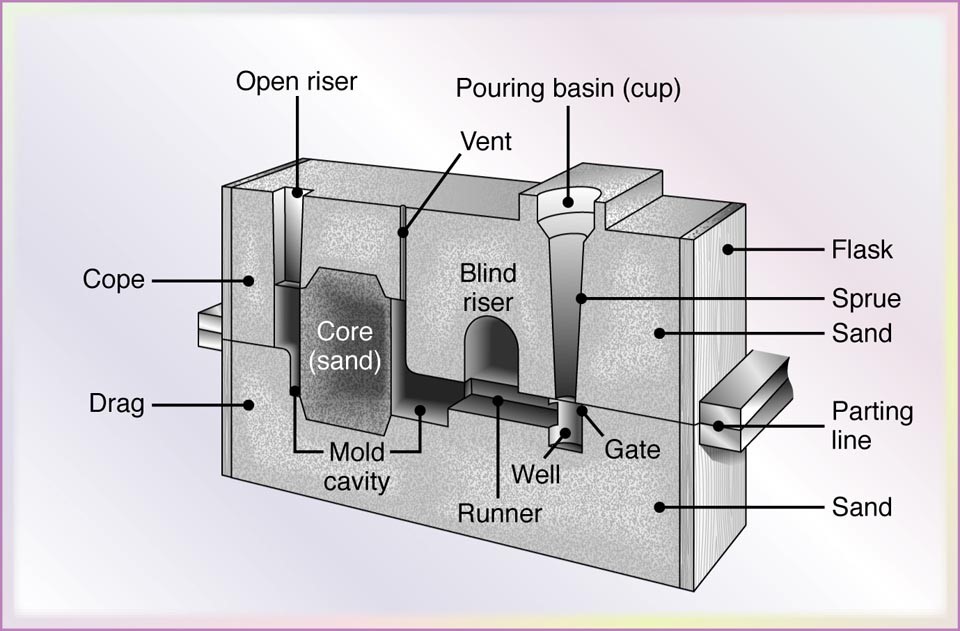
Cope and drag in Sand Mold :


Cope and Drag are the two parts of the casting flask. Cope is the upper part and drag is the lower part. Even if the casting process is flaskless , the same terms are used for the upper ans lower parts. Generally the flask is made of wood or metal. It contains molding sand. When metal is poured into the mold cavity the flask supports the mold.


Gating system:


If the molten metal is poured directly from the ladle , it will erode the bottom of the mould cavity. So molten metal is poured from the ladle to the cavity through a gating system. The gating system in casting creates a series of channels through which molten metal reaches the cavity. Gating system has -

  • Pouring Basin : It receives the molten metal from the liquid metal container. 
  • Sprue : Pouring cup is attached to the sprue. It is vertical in shape . On the other part of the sprue there is part called runner. 
  • Sprue Base : Its the base of the sprue
  • Runner : It is the horizontal part of the gating system. It connects the spues with the gates. 
  •  The next part is the choke. 
  • Then comes the skim bob 
  • Gates and ingates : It controls the movement of the metal from the runners into the cavity. 
  • Riser 

sand mold features

different parts of sand mold


Riser:

The risers are also known as feed heads. When the metal solidifies it starts to shrink. And then risers comes into play. These feeder supply metals to the cavity when shrinking of the metal starts. 

sand mold gating system for a horizontal plating mold


sectional view of a sand mold


Core:

Cores are required to create the castings with holes. It can be made of refractory materials. Most often core sand is used to make it. Metal cores are also available but less frequently used. 


Chaplets:

Chaplets are the supports for the cores. These are needed particularly when the cores are very big. Usually metal pieces are used to support the core. Without chaplets the core can be displaced and the casting can be spoiled. These chaplets are set-up between the core and mold surface. Caution should be taken while placing chaplets. Clean, oil and moisture free pieces should be used as chaplets. 


Chills:

These are huge metal pieces used to reduce the effect of shrinkage. These increases the thermal conductivity and heat capacity. It helps in speeding up the cooling process. So thick metal parts are cooled quickly. They can be used along with the risers. 

Please read : 

Read full post »

Lost Wax or Investment Casting Method Steps

12 comments
Investment or lost-wax castings:

The Lost-wax method, sometimes, also called simply as precision-investment casting has been used for many years by jewelers and dentists. Since world-war-II, the method has been adapted to the production of small and precise, industrial fasting. Basically, the method involves the use of expendable (heat disposable) pattern unrounded with a shell of refractory material to form the casting mould.  Example: Piston making.
Cast parts are formed by putting the molten metal in the cavity. The wax pattern is melted and it is not reusable because of that the method is named "lost - wax method".

Follow :

 The steps involved in this Lost Wax Method  method are explained below:
  • Wax injection
  • Assembly
  • Shell building
  • Dewax
  • Conventional casting
  • Knockout
  • Cut-off
  • Finished castings
   (a) Wax patterns are usually made by injection molding


   (b) Multiple Patterns are assembled in central wax sprue .


(c) The assembly is immersed in a liquid ceramic slurry. After that this structure is dipped into a bed of very fine sand. More than one layer of sand may be necessary.


(d) The ceramic becomes dry. The wax is then melted. To melt all the wax ceramic is fired.


(e) Simple gravity pouring is used for filling the mould. After solidification all the parts of the ceramic structure become casting. Hollow castings can be made by pouring out the extra metal before solidification.


(f) The metal cools to room temperature and after that the ceramic structure is broken off by water blasting or by applying vibration. 


(g) The parts are separated by the high speed friction saw. Minor finishing is given to the parts. 


Advantages of Investment Casting Method:
  1. Intricate details can be cast.
  2. Undercuts and other shapes, which would not allow the withdrawal of a normal pattern, are easily obtained.
  3. The surface is very smooth and there is no parting line.
  4. High accuracy can be obtained so that much of complicated and costly machining can be eliminated.
  5. Unmachinable alloys can be cast.
  6. More than one casting can be made at a time.
  7. It can be reused.
  8. Preferred for casting weight less
Limitations of Lost Wax Casting :
  1. It is involved and thus expensive
  2. It has limitations in use of and location of holes
  3. The parts are limited in size to a few kg
Application:
  1. Parts for aerospace industry
  2. Parts for computers
  3. Parts for food and beverage
  4. Costume jewellery
Please Read : 
Read full post »

Die Casting Principles

22 comments
Die casting process is very different from sand casting as the mould used here is permanent. The mould is not expandable and need not to be broken after the cooling and solidification. Here the mould is called the die. 

Please Read : 

Die Casting Principles

Gravity die casting:
When the molten is metal is poured under a gravity head into the permanent mould it is called gravity die casting. It is also known as permanent mould casting. 

Gravity Die Casting properties:
(a)    It uses permanent mould and cavity. 
(b)   Accurately machined. 
(c)    Decent thermal conductivity 

Applications of gravity die casting 
These are used to make precision aluminum precision casting parts, machine parts, motor parts, heavy metal parts. 

Pressure die casting:
When molten metal is injected into the permanent metallic mould by the means of the external pressure it is known as die casting or pressure die casting. In this process the liquid metal is forced into the permanent die. 

Applications of pressure die casting  
Cast parts obtained from pressure die casting are used in automobiles , electrical equipment, motors, machine parts, telecommunication equipment, building materials, auto ancillary and many other sectors. Home appliances and children's toys also use pressure die cast parts . 

Please Read : 
Read full post »

Sand Casting Process with Diagram

16 comments
Sand casting:
In sand casting which is also known as sand molded casting, an object is produced by sand mold. The process involves pouring of the molten metal in to the mold cavity. The molten metal is then cooled to the room temperature. The metal is solidified. After cooling, the metal object is separated from the mold.  Sand casting process has its advantages and disadvantages. So care should be taken while making delicate products. 

The six  main steps in this process are - 
  • Pattern making and placing it the sand mold. 
  • Making a proper gating system in the mold. 
  • Removing the pattern. 
  • Pouring the molten metal in the mold cavity. 
  • Cooling the mold to the room temperature. 
  • Breaking the mold and getting the casting. 
Please read : A complete guide to steps involved in casting process 

Before making the mold the properties of the molding sand should be checked.  There are different types of molding sands. Each type of sand is used in molding according to the cast materials and application of the materials. Mainly Green or Natural and Synthetic Sands are used

Another important factor is the pattern. Different types of patterns are available . Before making patterns these thing should be kept in mind. 


sand casting process


sand casting process diagram


Production steps in sand castings:

steps in sand casting


Figure: Steps involved in sand casting. This production sequence involves casting operation and pattern and mold making. 

After removing the casting engineers should look for the casting defects. If the defects are there then it should be identified. 

Please read 


Read full post »

A Complete Guide to Steps Involved in Casting Process

5 comments
We know that casting is the process of pouring molten metal in a desired shaped cavity and allowing it to solidify. After the solidification we get the desired shaped object.

Please read :


Basic Operation of the casting process
  • First we have to make a pattern 
  • Then the we have to melt the metal by applying heat 
  • pouring the metal into the mold and confirming that the metal gets the desired shape. 

What is Pattern in Casting Process  

Pattern is the object used to make cavity in the mold. The molten metal is poured into this cavity.

Why a good Pattern is required in casting ? 

  • To obtain the desired shape and size. 
  • It is easy to design and manufacture. 
  • making a pattern is not expensive. 
  • It is of high strength. 
Pattern Materials 
  • Wood 
  • Cast Iron / Brass 
  • Aluminum or White metal 
  • Plastic gypsum 
For a complete knowledge of pattern materials go to this link

Pattern Allowances 

  • Shrinkage allowance (due to cooling)
  • Machining allowance (due to machining)
  • Shaking allowances (due to rapping)
  • Draft allowance (follow the link)
  • Distortion allowance (due to irregular shape) 
For a complete knowledge about the allowances in patterns follow this link
Different Types of Patterns used in Casting 

  • Split piece pattern 
  • Match plate pattern 
  • cope and drag patterns 
  • sweep patterns 
  • draw backs 
  • Loose piece pattern 
  • Gated pattern 

Preparing Mould for the Casting 

While preparing mould one should be very careful . Different types of sands and binders are used in mould preparation. These are 

Green sand mould: Natural sands , clay and water is used in making green sand mould. It is very cheap with acceptable errors.  

Dry Sand Mould: It is natural sand mould with cereal and pitch used binders. 

Other materials for mould preparation includes silica sand and binder with additives. 

Please Read : 

Different Properties of the moulding sand 

These are the desired properties of the moulding sand 
  • Refractoriness 
  • Cohesiveness 
  • Permeability 
  • Co-efficient of expansion 
  • Adhesiveness 
  • Collapsibility 
  • Plasticity 
For details of each of the properties follow this link : 


Tests for the different moulding sands 
  1. Moisture Content Test 
  2. Fineness Test 
  3. Testing Amount of Clay 
  4. Permeability Test 
  5. Mould hardness test 
  6. Strength or cohesiveness test 

Core Making 

What is Core ? 
It is a structure made of refractory material . It is prepared before pouring the molten metal on to the cavity. There is another term known as core print which is the projection on a pattern used to make spaces in the mould. It is also known as core seat. 

Criteria for selecting a furnace for casting 

  1. Capacity needed to hold the molten metal 
  2. Melting rate 
  3. Quality of the melt 
  4. Temperature needed 
  5. Method of pouring 
Operation in Cupola Furnace 

Cupola is the most popular furnace for casting non ferrous and ferrous materials . It is known as a shaft furnace. The shell of cupola furnace is made of steel of 8-10 mm thickness. The shell is supported by columns or legs. The inside of the furnace is lined with refractory material to save the furnace from over heating.  

Different types of casting processes 

  1. Sand Casting 
  2. Shell Mold Casting 
  3. Expandable Mold Casting 
  4. Plaster Mold 
  5. Ceramic Mold 
  6. Investment Mold or Lost Wax Casting  
  7. Permanent Mold 
  8. Die Casting 
  9. Centrifugal casting 
Casting Defects 


steps involved in casting process


And lastly comes the casting defects. These defects can occur for different reasons like air trapping in the sand mold, low quality sands, improper ramming , defecting sand mold etc. Go through this link for detailed knowledge of casting defects.


Read full post »

Different Types of Pattern Allowances in Casting

25 comments

Pattern allowances:

There are some allowances which are responsible for the difference in the dimensions of the casting and the pattern. These allowances are considered when a pattern is designed for casting. In this article we will discuss those allowances -

Different types of Pattern Allowances in casting process

1.     Shrinkage allowance:

After solidification of the metal from further cooling (room temp.) dimensions  of the patterns increases. So pattern size is bigger than that of the finished cast products. This is known as shrinkage allowance. 

It depends on:
a)      Dimensions of casting
b)      Design and intricacy of casting
c)       Resistance of mol to shrinkage
d)      Molding materials used
e)      Method of molding used
f)       Pouring temp of the molten metal

2.     Draft or taper allowance:

Pattern draft is the taper placed on the pattern surfaces that are parallel to the direction in which the pattern is withdrawn from the mould (that is perpendicular to the parting plane), to allow removal of the pattern without damaging the mould cavity.

It depends on:
a)      the method of molding
b)      the sand mixture used
c)       the design (shape and length of the vertical side of the pattern)
d)      economic restrictions imposed on the casting
e)      intricacy of the pattern

3.     Distortion allowance:

This allowance is taken into consideration when casting products of irregular shapes. When these are cooled they are distorted due to metal shrinkage.

4.     Finishing or machining allowance:

Machining allowance or finish allowance indicates how much larger the rough casting should be over the finished casting to allow sufficient material to insure that machining will "clean up" the surfaces.

This machining allowance is added to all surfaces that are to be machined. Machining allowance is larger for hand molding as compared to machine molding.

It depends on:
a)      Machining operation
b)      Characteristics of metal
c)       Methods of castings
d)      Size, shapes and volumes of castings
e)      Degree of finish required in castings
f)       configuration of the casting

5.     Shaking or rapping allowance:


Read full post »

Match Plate Pattern - Used in Casting (With diagram)

0 comments
What is Match - Plate Pattern 


The match plate pattern is almost similar to the mounted pattern but it can have part of the casting in the cope and part in the drag like split piece pattern. These parts are generally attached to the plate / board in opposite sides in the perfect positions. When the plate is removed and mold is in close position the cavities in the cop and drag match perfectly. The mounting procedure matches the procedure of one sided mounted plate.

match plate pattern used in castings
schematic of match plate pattern

Characteristics of Match Plate Pattern 


  • It is split pattern 
  • Cop and Drags on the opposite site of the metallic (generally) plate. 
  • The gates are runners are on the match plate. 
  • Can be used for large number of casting with very little hand work. 
  • A match plate can be single pattern or a combination of many small patterns
  • Example : IC engine piston rings can be produced by match plate pattern 

Important parts of Match Plate Patterns  


Cope and Drag Mounts

  • Two separate pattern mounts are there.
  • One is fitted to the female guides (for drag) other is fitted with pins (for cope). This must match the profile of the flask that is used.
  • The half part of the pattern associated by the cope is attached to the cope mount and drag part pattern is attached to the drag mount.
  • Cope and drag portions are manufactured disparately and combined together for pouring.
  • Generally one molder makes copes other makes drags.
  • Cope and drag mounts are also known as tubes.
  • These (cope and drag mounts) are very similar when producing large castings. 


cope and drag mounts in match plate pattern
cope and drag mounts in match plate pattern 
Follow board

  • It is a board with a cavity or socket.
  • The cavity must conform to the shape of the pattern.
  • It also defines the parting surface of the drag.
  • Materials: It can be made of plaster or metal. If sand is used to manufacture follow board then it is called dry sand match.
  • When the drag half of the mold is made the pattern rests on the follow board.
  • It creates the correct sand parting.
  • Pattern is rammed in the drag and follow board is removed.
  • The follow board is replaced by the cope.
  • A simple follow board may have a hole in it so that the pattern rests firmly when the drag is being rammed.   


follow board

simple follow board
Please Read :
Read full post »

Water Jet Machining (WJM) Advantages and Disadvantages

14 comments
        In Water jet Machining no abrasive is used. Water jet alone is used for cutting. In WJM, materials like concrete, asbestos, wood, rocks, coal, textiles and leather can be cut. The material is removed by means of erosion. These days hydraulic coal mining as well as tunneling, descaling and cleaning is also done by this process. 


         Water Jet Machining (WJM) Principles 


As the name suggests the water jet machining process involves the use of high velocity  and high pressure thin jets of water to cut the job. Water Jet is the stream of high velocity water coming out from the nozzle. When high pressure water jet comes out of the nozzle it gains a large kinetic energy. After striking the work piece this kinetic energy is converted to pressure energy inducing high stress on the material. When this induced stress surpasses the ultimate stress of the material, removal starts

Please Read :  


         Schematic Diagram of WJM 


        The schematic diagram of  WJM process is very similar to that for AJM. To raise the pressure of the water a pump or intensifier is used. The system pressure ranges from 1600 to 4000 N/mm2. The accumulator used in the system act as a pulsation remover and an energy reservoir. Water passes through the accumulator and then nozzle through a high pressure thick tube. The tube material may be stainless steel jacketed with carbon steel. Sintered diamond , sapphire or tungsten carbide may be used as the nozzle material. The exit dia. of the nozzle may vary from 0.05 to 0.35 mm. 


Water Jet Machining (WJM) Advantages and Disadvantages
a. Schematic of Water Jet Machining b. Example of workpiece machined by WJM


Advantages of Water Jet Machining Process 

1. Here water is used for cutting which is cheap, non-toxic and readily available. 
2. The water jet keeps the job clean and dust free. 
3. The only moving part used is the pump, therefore the operating and
maintenance expenses are low. 
4. The process is very safe to use. 
5. Very complicated designs and detailed work can be done. 
6. There is no damage of the workpiece due to thermal stress. Very little heat is
generated. 
7. Soft rubber like materials can be cut through this process where saw teeth
gets clogged. 
          

Disadvantages of WJM.

1. Hard Materials cannot be cut. 
2. The initial cost is high. 

Applications:

1. Cutting 
2. Milling 
3. 3D Shaping
4. Turning
5. Piercing
6. Drilling
7. Polishing 
Read full post »

Different Sand Casting Process- Advantages and Disadvantages

6 comments
If it is assumed that a single process is good enough to approach practical problems in production then it is a total non-sense. There are a lot of methods useful for manufacturing goods. The most difficult part is selecting the right method of production. For manufacturing a product one should bear in mind its appropriate configuration, financial conditions and adequate supplies of materials and man power. Sand casting process is much more suitable for the people who are capable of solving problems in a clever and better way. The cutting edge technology for manufacturing products needs a huge capital. On the contrary sand casting process is good for the small industries with limited resources.
Please Read :


There are many alternatives of casting. But when the resources are limited then casting is best suited for producing metal objects. The alternatives of sand casting process are:


Experienced craftsmen of artisans will definitely try to use a combination of these processes.  


Advantages of Sand Casting Process 

  • If the above mentioned alternative methods don't produce any particular advantage then the solution to the problem of production method may be lies in casting. The main advantage of sand casting process is it produces identical products cheaply. 
  • It produces precision objects which is not possible in any other process. 

Types of Sand Casting process 

The choice of sand casting process depends on some important parameters. These are -
So for large quantity production along with low cost the majority will prefer sand. But in cases of small quantity precision products lost wax. On those cases the precision is the main factor and the factor of cost is ruled out .

What is Sand Casting ?

Sand casting is a metal casting process which involves the use of natural sand along with adequate proportion of clay (as a binder material) to keep the sand grains together or it can use the silica sand and artificial binder pair. The mixture is then contained in a moulding flask or moulding box consisted of two matching parts . The mixture in the box is compressed by hand or mechanical ramming is done around the pattern. A parting sand is used between the two halves of the moulding flask. When the these boxes are separated after establishing the sprue system by patterns and the dowels a negative mould shape is left behind in the moulding sand. The molten metal is then poured into that hollow section or cavity. These are the basic steps of sand casting used for metal casting.


sand casting process advantages and disadvantages


Different sand casting processes and their pros and cons  

Sand casting process involves the use of different types of sands and binder pairs. There are different types of molding sand in a casting process. And the quality of the casting depends on the properties of various natural and synthetic molding sands.  Below the main types of sand casting processes are discussed with there advantages and limitations along with comparisons.

Green Sand Moulding 


This process involves the use of natural sand which already have a small percentage of clay.  The green sand casting process involves the following basic steps. 

  • Adequate amount of water is added to the sand. 
  • After adding water the green or natural sand is thoroughly conditioned and mixed with the help of rollers. The clay and water works as binder which holds the sand grains together. 
  • The sand is compressed around the pattern and rammed so that it becomes compact and tight. And this is known as 'Green Strength'. 
Advantages of green sand moulding

1. Appropriate for long production runs 
2. Very low cost process. 
3. Materials are available in all around the world. 
4. The process is versatile 
5. The sand is reusable. 

Disadvantages of green sand moulding

1. It needs skilled workers and craftsmen. 
2. Intricate Patterns are not very suitable. 
3. Surface Finishing is not good. Needs additional machining. 

Dry sand casting process 

The main concentration of dry sand casting process is on Iron casting. Major features are 

  • This mixture is rich in clay. 
  • The rammed sand is more compact. 
  • It needs well ventilation with the appropriate  use of venting rod. 
  • Sand must dried before pouring the molten metal into the mould.  
Advantages of dry sand casting 

1. Dry sand moulding gives a closer and finer grain structure which is suitable for large and heavy castings. (typically for iron castings buy not exclusively). In heavy castings natural sand has the tendency to become weaker when baked and dried. 
2. Dry sand controls excessive gassing and porosity as a result gives a better dimensional accuracy. 

Disadvantages of dry sand casting  

1. Sand needs meticulous blending and preparation. 
2. To unleash the trapped gases dry sand moulding needs ample and thorough venting. 
3. Kiln and fuel is needed because the mould is needed to be baked. 

Carbon dioxide-silica sand moulding 

In comparison to CO2 - Silica moulding process, sometimes the green sand process seems obsolete. In this process - 
  • Sand grains are bound together with the use of Sodium Silicate and it is hardened by the use of Carbon dioxide gas. 

Advantages of carbon dioxide-silica sand moulding 

1. Semi-skilled worker can do the work. 
2. It is a very versatile process. 
3. It produces very good surface finish. 
4. Used for long  production runs 
5. The distortion is negligible. 

Disadvantages of carbon dioxide-silica sand moulding

1. It is a expensive process. 
2. Thorough mixing of the materials is very necessary. 
3. Gathering all the materials is not easy. 
4. It needs careful mixing which involves the use of mechanical means. 
5. A common fault is poor surface finish because of over gassing. 
6. If sand reclamation plant is not present then the sand cannot be reused. 

Synthetically bonded sand casting process 


  • This process uses silica sand. 
  • Synthetic resin is used as a binder. These binders can be air set, or thermo set or can use catalysts. 

Floor Moulding process 


  • This process is used mainly for large castings alone. 

Advantages of floor moulding 

1. Materials are readily available. 
2. Suitable for huge castings. 

Disadvantages of floor moulding 

1. The application of floor moulding is very limited . 
2. It needs very experienced workers. 

Loam Moulding Process 


Used for large one-off casting processes which may involve "oil bonded sand". Here a vegetable oil is used for oxidizing or drying the sand.  


Advantages of loam moulding process 

1. A great method for casting a single piece or a small number of heavy and large castings. 
2. Most of the times motor casings, bells and fly wheels are cast by this process which means that this process is very much suitable for casting cylindrical, conical and domed shape materials. 
3. The caster can use a strickle as a substitute of large and costly patterns. 

Disadvantages of loam moulding process 
1. Not suitable for large quantity production. 
2. This process is almost died out. These days it is used merely in the bell foundries. This process also needs great technical skills. 

These are the main sand casting processes which are useful in different fields. A well experienced blacksmith or caster would well utilize the advantages and disadvantages of all the sand casting processes. There are also processes like die casting, lost wax casting, centrifugal castings, lost mercury process and lost polystyrene process which all are useful in different fields, 

Please Read: 


Read full post »

Comparison of casting processes

0 comments
Here are the Comparison of casting processes in a table. Thanks. Feel free to comment. 
Castings process name
advantages
Disadvantages
Sand castings
Ä      Any metal can be cast
Ä      No limit size and shape
Ä      Less equipment cost
Ä      Economic for low volume production
Ä      Coarse final
Ä      Dimensional accuracy is not good
Ä      Finishing required
Ä      Less production rate
Individual casting
Ä      Any metal can be cast
Ä      Good surface finish and dimensional accuracy
Ä      Fairly high production rate
Ä      Less finishing cost
Ä      Interlaced shape can be cast
Ä      High labor cost
Ä      Expensive patterns and mold
Ä      Limitation on part size
Die castings
Ä      Excellent surface finish
Ä      Excellent dimensional accuracy
Ä      High production rate
Ä      Complex shape can be cast
Ä      Little or no finish cost
Ä      Limitation on part size
Ä      High cost of die
Ä      Generally limited to casting of non ferrous metal
Lost-wax casting
Ä      High production rate
Ä      Good dimensional accuracy
Ä      Good surface finishing
Ä      Expensive setup
Ä      Good for production of cylindrical parts only
Centrifugal casting
Ä      No limit size and shape but mainly spherical
Ä      Surface finishing smooth
Ä      Not all alloys can be cast in this way
Ä      An inaccurate diameter of the inner surface of the casting
Read full post »
 

Copyright © Mechanical Engineering Design by Free CSS Templates | Blogger Theme by BTDesigner | Powered by Blogger